
Dog Walking in Oxfordshire #2 Watlington Hill Walk: A Beautiful Dog-Friendly Walk in the Chilterns

Updated: Oct 2
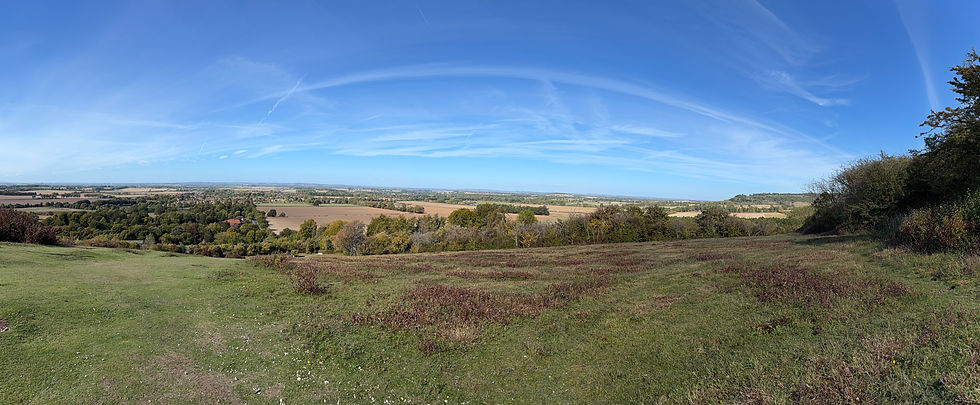
If you’re looking for a beautiful dog walk in Oxfordshire with wonderful views, varied countryside and plenty of wildlife, Watlington Hill is well worth exploring.
Managed by the National Trust, Watlington Hill sits on the Chilterns escarpment and combines ancient yew woodland, open chalk grassland, scrub and far-reaching views across the Oxfordshire countryside. Red kites are a particularly common sight overhead, while deer, rabbits and a variety of birds and butterflies also make their home here.
I visited with Nellie on a beautiful sunny day and followed a short circular route which took us around 38 minutes at a moderately brisk pace. It’s not a long walk, but don’t let the distance fool you: there are some surprisingly steep sections.
Parking at Watlington Hill
There is a National Trust car park at the top of Hill Road, with space for around 30 vehicles. National Trust members can park free of charge, with registration required, while non-members pay to park.
It’s worth knowing that the car park can become busy, particularly at weekends. The National Trust asks visitors not to park along the road if the car park is full, as this can cause problems for local traffic and damage the important roadside habitats.
There are no toilets, café or drinking-water facilities at the hill itself, so come prepared, particularly if you’re visiting with children or dogs.
Choosing the route
There are different ways of exploring Watlington Hill, and you could of course walk the circular route in either direction.
We particularly like starting from the extreme left-hand side of the car park, rather than taking the path immediately beside the parking payment machine.
From the far left of the car park, look for the track leading downhill into the trees. This is the route we followed.
There is a good reason we prefer this direction: the spectacular views come later.
Rather than seeing the best of the landscape almost immediately, the walk gradually unfolds. You begin in the woodland, descend through the trees and follow the winding path before eventually emerging into the open countryside.
It makes those first views across Oxfordshire feel like a proper reveal.
Through the woodland
From the extreme left of the car park, we followed a narrow track downhill through the trees.
This first section feels quite different from the open countryside that comes later. The path is surrounded by trees, with relatively little light reaching the ground except in patches, and the route is narrow, winding and uneven.
There are plenty of exposed tree roots, and the earth path could become slippery and muddy after rain. It’s certainly not a route I’d recommend for pushchairs, buggies or wheelchairs.
There is also a fenced field alongside part of the path. Although there were no livestock in it during my visit, it’s something to bear in mind if you’re walking with a dog.
A word of caution for dog owners
One thing I noticed particularly was some deer-style fencing in the woodland which is surprisingly difficult to see.
If you have a dog that likes chasing squirrels or deer, this is worth being aware of. A dog running through the trees at speed might not spot the fencing until it’s too late.
The National Trust confirms that deer are among the wildlife found at Watlington Hill, so keeping a dog under control around woodland and open countryside is sensible.
Yew woodland and chalk grassland
After around five minutes of descending, the character of the walk begins to change.
The trees open up and the path becomes more level, with pale chalky ground underfoot and glimpses of the countryside beginning to appear through the trees.
Watlington Hill is particularly interesting because of the unusual combination of habitats here. The chalk grassland supports a wide range of wildflowers, butterflies, birds and other wildlife.
The woodland contains some magnificent old yew trees too, several of which are hundreds of years old.
The mixture of evergreen yew and native deciduous trees gives this part of the walk a lovely sense of variety. The path meanders gently through the landscape, sometimes enclosed by trees and sometimes opening out to reveal glimpses of the countryside beyond.
Underfoot, the stones can be a little slippery, so sensible footwear is advisable.
The views finally reveal themselves
After around 13 minutes, we reached a kissing gate.
Rather than continuing straight ahead, we turned sharply right at this point and began climbing.
This is where the character of the walk changes again.
Nellie was having a wonderful time exploring and, having passed the fields, was able to enjoy some time off lead.
The path is narrow and fairly steep as it winds around the field, but gradually the trees begin to fall away.
And then you reach the open hillside.
This is the moment that makes taking this direction worthwhile.
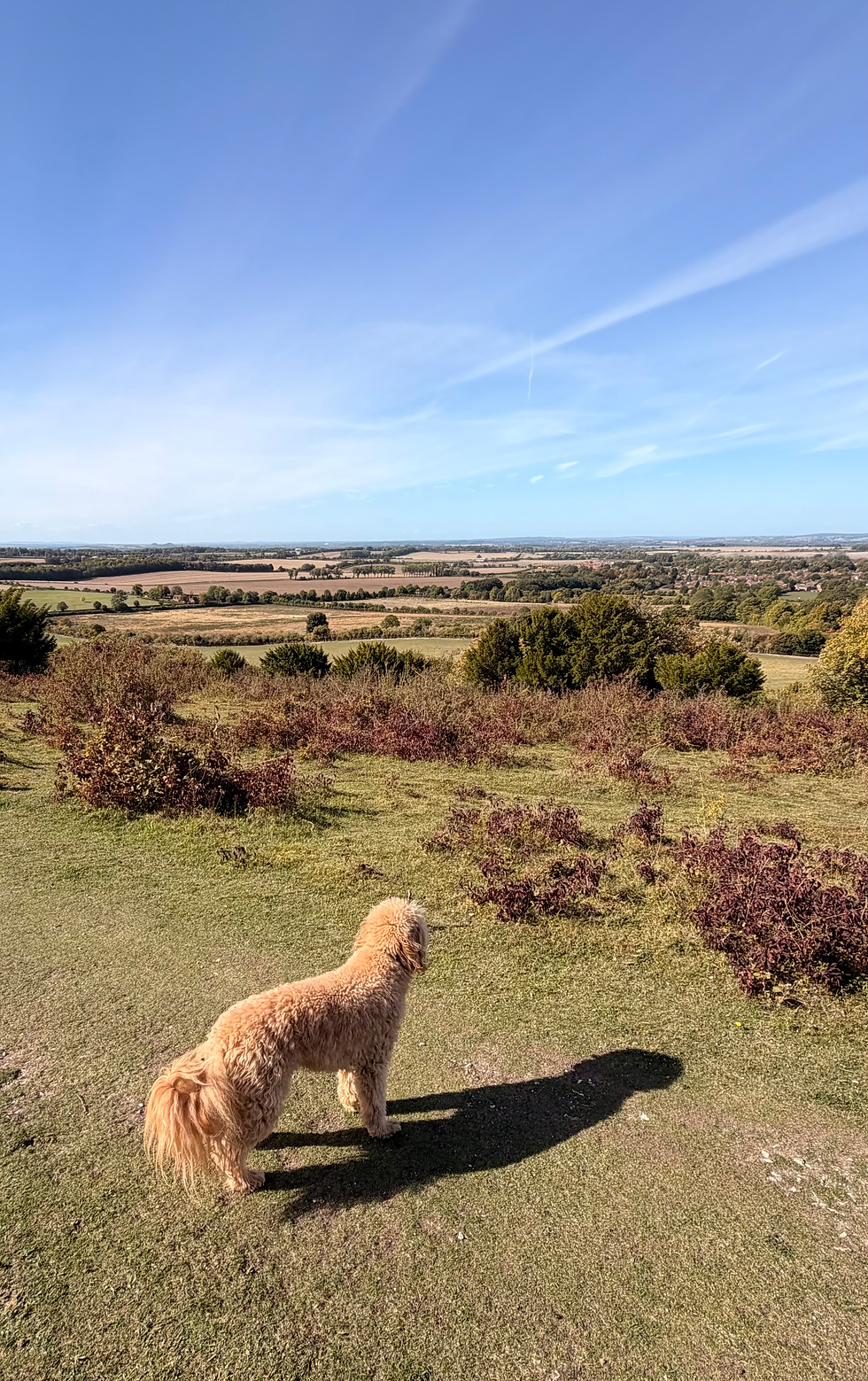
After spending the first part of the walk largely enclosed by woodland, you suddenly emerge onto open chalk grassland with spectacular views across Oxfordshire.
The contrast is wonderful.
The landscape here is much more open, with very short grass, shrubs and relatively little tree cover. It feels expansive after the enclosed woodland, and there are several places where you can simply stop and take in the view.
There are benches positioned along the route too, providing an ideal place to sit for a while.
And keep looking upwards. Red kites are a familiar sight here, soaring above the escarpment on the thermals.
The climb to the top
The main ascent is quite steep.
I’m reasonably fit, but walking uphill at a moderate pace certainly left me slightly out of breath. It’s therefore worth taking your time, particularly if you’re walking with an older dog or anyone who isn’t used to hills.
The landscape here is wonderfully open, with short grass, shrubs and scattered trees. Oak, hawthorn and gorse add texture to the hillside, while the absence of dense woodland allows those expansive Oxfordshire views to really dominate.
It’s a proper little hill walk rather than simply a gentle stroll.
A peaceful return through the countryside
After around 30 minutes, we reached a more level section at the top of the hill and began making our way back towards the car park.
The path continued to meander across the hillside before reaching a five-bar gate.
This is another point where I’d consider putting your dog back on the lead if they are inclined to wander. There is a road nearby which isn’t immediately obvious because of the surrounding trees.
Interestingly, despite being relatively close to a road, the area felt wonderfully peaceful. There was very little traffic noise and it was easy to forget that you’re not deep in the middle of the countryside.
There is a clearly marked path alongside the five-bar gate, and from here the route eventually brings you back towards the car park.
How long does the Watlington Hill walk take?
Our circular walk took approximately 38 minutes, walking at a moderately brisk pace and without stopping for long periods.
Of course, this isn’t necessarily how long the walk will take everyone.
With children, a dog who wants to investigate every bush, or simply a desire to stop and enjoy the views, you could easily spend considerably longer here.
And I think that’s part of the appeal.
It’s a relatively short walk that feels much more substantial because of the variety of landscape you experience along the way.
Is Watlington Hill suitable for dogs?
Yes, but with some qualifications.
Watlington Hill is an excellent place for dogs who enjoy exploring woodland, grassland and open countryside.
However, I’d recommend being particularly mindful of:
uneven ground and exposed roots
steep sections
slippery stones and muddy conditions after rain
deer and other wildlife
fencing which can be difficult to see
livestock in neighbouring fields
roads near parts of the return route
A dog with a good recall will have plenty to explore, but this isn’t somewhere I’d allow a dog simply to disappear over the horizon.
After the walk: Spire & Spoke, Watlington
If, like me, you enjoy finding somewhere good for a coffee or a drink after a walk, there’s a particularly convenient option nearby.
Turn left out of the Watlington Hill car park and head towards Watlington. In around three minutes by car, you’ll reach Spire & Spoke on Hill Road.
It’s a lovely place to finish the walk, with an attractive garden and plenty of outdoor seating. There are also small, open-fronted cabins where you can sit outside.
The pub is popular with cyclists and walkers and is dog-friendly, making it particularly convenient after a countryside walk.
There’s coffee, homemade cakes and savoury snacks, alongside craft beers and wood-fired pizzas.
It also has a lovely connection with the landscape you’ve just walked through: from the garden, you can see Watlington Hill and its famous triangular chalk White Mark.
Final thoughts
Watlington Hill is one of those walks that manages to pack a surprising amount into a relatively small area.
You begin among trees, following a narrow woodland path, before emerging onto open chalk grassland with expansive views across Oxfordshire. There are old yew trees, red kites overhead, wildlife in the surrounding countryside and some properly hilly sections to get the heart working.
And although you can walk the route in either direction, I’d recommend our direction if you’re visiting for the first time. Starting at the far left of the car park means that the walk gradually builds towards those spectacular views rather than revealing them at the beginning.
It’s a small detail, but it changes the experience.
It’s not a walk I’d recommend for anyone looking for a completely flat, accessible route, but for reasonably mobile walkers and dogs who enjoy a mixture of woodland and open countryside, it’s a lovely place to spend an hour or two.
And on a clear day, those views are difficult to beat.
For me, there’s something particularly appealing about walks like this. They’re not about covering huge distances or ticking off a route. They’re simply about being outside, exploring somewhere beautiful with your dog and having time to enjoy the countryside together.
If you’re looking for dog-friendly walks in Oxfordshire, Watlington Hill is certainly one to put on the list.
what3words address
///survived.crows.clings
https://w3w.co/survived.crows.clingsIf you're looking for a gentler walk nearby you could try our Brasenose Wood walk
Photography
Watlington Hill is also a wonderful location for dog photography, if you'd like to find out what I can offer please follow this link


Comments